How we calculate
How we turn the public EPC registers into today's heating cost — and why it remains an estimate.
The data
Scottish domestic EPC register (dataset to Q1 2026, Scottish Government) and the England and Wales domestic EPC register (Ministry of Housing, Communities and Local Government, download of October 2026). We keep the latest certificate per dwelling.
Today's cost
Prices: Ofgem price cap for 1 October – 31 December 2026 (electricity 26.32 p/kWh, gas 7.97 p/kWh plus 29.68 p/day standing charge; Great Britain average).
Scotland. The certificate gives the heat demand for space heating and hot water (kWh a year). We divide it by the efficiency of the heating system — ranges assumed by this site: gas boiler 0.75–0.88, electric 1.0, air-source heat pump 2.3–3.0, ground-source 2.8–3.5 — and apply the cap.
England and Wales. The register gives no heat demand. We take the certificate's primary energy (kWh/m² a year × floor area), convert it back to energy bought with the primary energy factors of the method the certificate used (SAP 2012: gas 1.22, electricity 3.07; from June 2025, SAP 10.2: gas 1.130, electricity 1.501), remove lighting, and apply the cap. The range covers the lighting estimate and ±5 % for the conversion.
Oil, LPG, solid fuel, community heating and electric storage heaters (off-peak tariffs) have no capped price and are not recalculated: the EPC's own, dated figure is shown.
Limits
The EPC is a standard assessment, not a measurement of real use: occupants, thermostat settings and tariffs change the bill. Ask for actual bills.
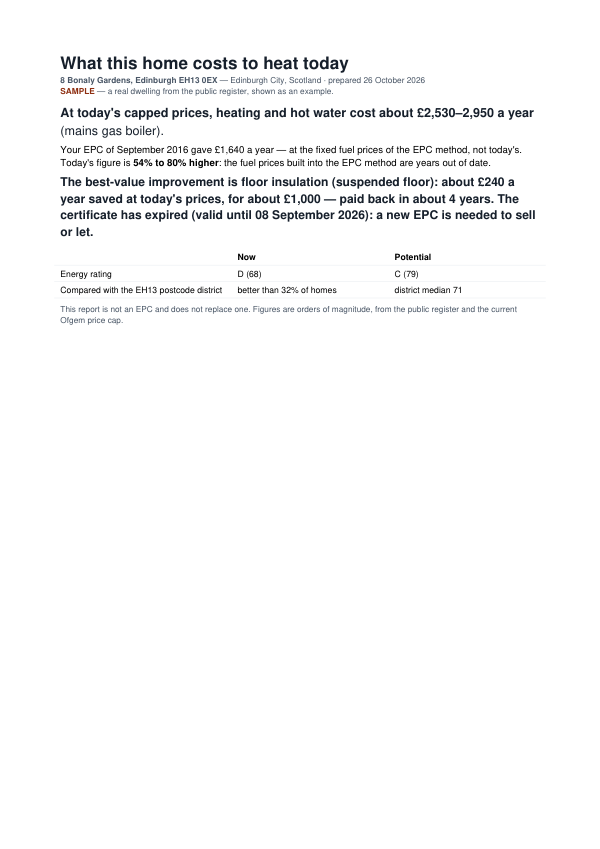
What this home costs to heat today — the EPC explained
An EPC states costs at the fixed fuel prices of its calculation method — years out of date. The report recalculates heating and hot water at today's Ofgem price cap, checks whether the certificate is still valid, says what each improvement saves today and when it pays back, and compares the home with its postcode district. PDF within 24 hours; you pay after you receive it.